Every major shipyard presentation in the past eighteen months has featured the letters 'AI' somewhere in the deck. Lürssen mentions machine learning in hull form optimisation. Feadship references predictive analytics in its sustainability roadmap. Smaller studios use generative imagery to pitch concepts that would have taken weeks to render manually.
The question is not whether AI is entering yacht design. It clearly is. The question is whether it's changing anything fundamental — or simply making existing processes faster.
Hull Form Optimisation
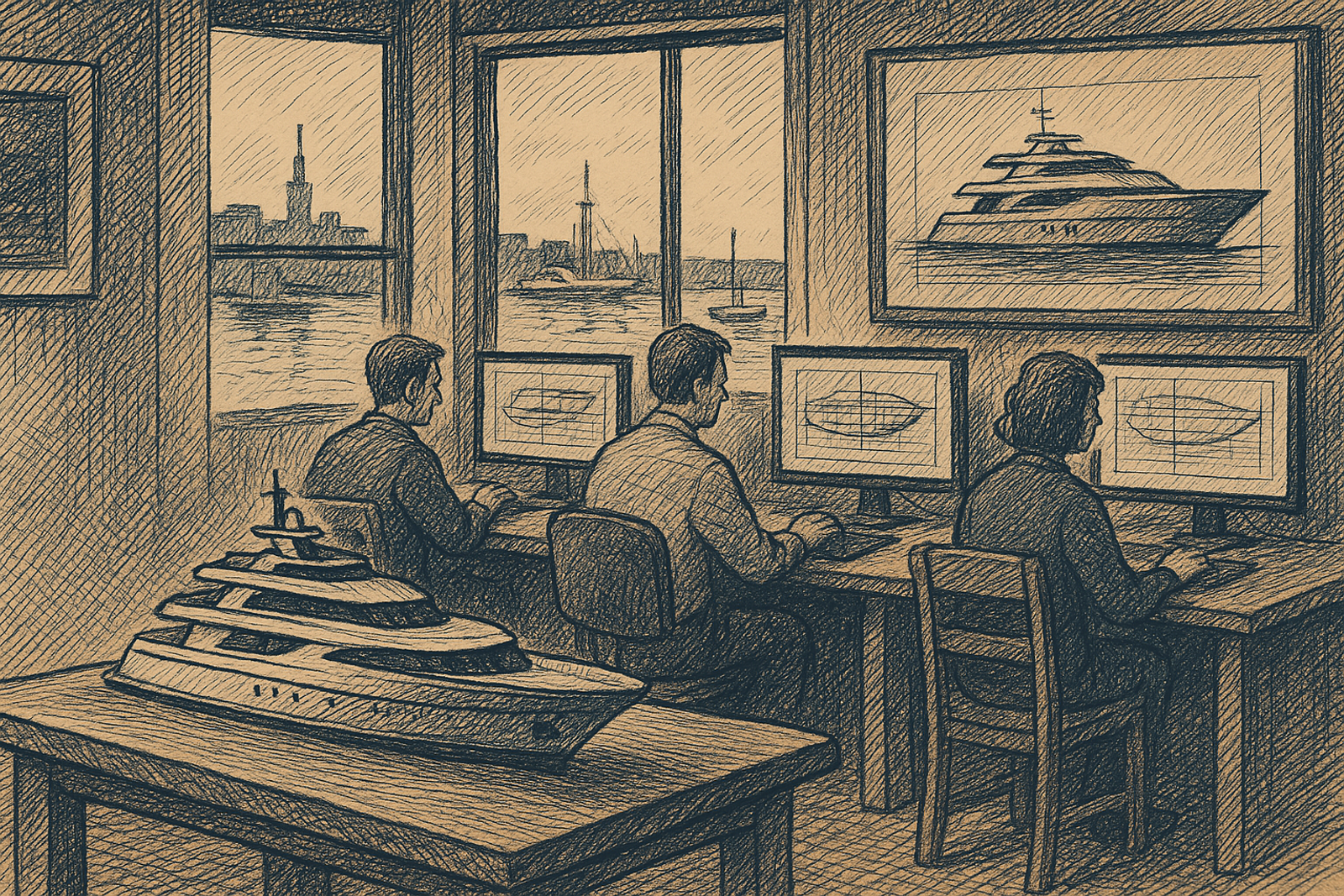
This is where AI delivers genuinely measurable value. Computational fluid dynamics (CFD) has been used in yacht design for decades, but traditional CFD analysis of a single hull form takes hours or days of processing time. Testing variations means running dozens of individual simulations.
Machine learning changes the equation. By training models on thousands of previous CFD analyses, designers can now evaluate hull form variations in minutes rather than days. The AI doesn't replace the naval architect's judgment — it accelerates the exploration of design space.
Marnaut, the Dutch naval architecture firm, reports that ML-assisted hull optimisation has reduced their design iteration time by approximately 60%. More importantly, the broader search space has produced hull forms that human designers wouldn't typically consider — shapes that look unconventional but demonstrate measurably superior hydrodynamic performance.
"The interesting designs are the ones the AI suggests that we would never have drawn ourselves," says a senior naval architect at a leading Dutch yard. "Not because we couldn't — but because our intuitions are shaped by what we've seen before. The machine has no such bias."
Interior Design and Personalisation
Interior design is where AI hype outpaces reality most dramatically. Several design studios now offer AI-generated concept renderings — impressive images produced in hours rather than weeks. For early-stage client presentations, the speed advantage is genuine.
But the gap between an AI-generated rendering and a buildable interior remains enormous. Material specifications, structural integration, systems routing, regulatory compliance — none of these are addressed by image generation. A beautiful AI rendering of a master suite tells you nothing about whether the plumbing can actually reach that location or whether the structural bulkhead allows the window placement shown.
Where AI does add value in interiors is in lighting simulation and acoustic modelling. These are computationally intensive tasks where machine learning can dramatically reduce processing time while maintaining engineering accuracy.
Predictive Maintenance
Perhaps the most practical near-term application of AI in yachting sits not in design studios but in engine rooms. Predictive maintenance systems — which analyse sensor data from engines, generators, and HVAC systems to anticipate failures before they occur — are now commercially available and increasingly reliable.
Rolls-Royce's intelligent awareness system, deployed across both commercial and yacht applications, uses machine learning to analyse vibration patterns, temperature trends, and operational data to predict component failures days or weeks before they become critical.
For yacht programmes, the implications are significant. An unplanned engine failure during a charter can cost $100,000 or more in lost revenue and emergency repair mobilisation. A predicted failure can be addressed during a scheduled maintenance window at a fraction of the cost.
The Marketing Problem
The challenge for the industry is distinguishing genuine AI capability from marketing language. When a shipyard says it uses 'AI-enhanced design', it might mean machine learning hull optimisation — or it might mean someone ran a concept through Midjourney.
Buyers should ask specific questions: What data does the AI system train on? What measurable improvements has it produced? Can you show comparative performance data between AI-assisted and traditional design approaches?
The yards and studios doing genuine AI work are typically happy to discuss methodology in detail. Those using AI primarily as a marketing term tend to retreat into generalities.
Where This Goes
The honest answer is that AI in yacht design is early-stage but real. The applications delivering measurable value today — hull optimisation, predictive maintenance, lighting simulation — are specialised and technical. The broader promise of AI-designed yachts remains years away from practical reality.
What's changing fastest is not the yachts themselves but the process of designing them. Studios that embrace AI as a tool for exploration — a way to test more ideas, faster — will produce better work. Those that use it to replace human judgment will produce impressive images and mediocre boats.
As one veteran designer put it: 'AI is the best intern I've ever had. Incredibly fast, endlessly patient, no ego. But I wouldn't let it sign off a general arrangement drawing.'